

by Kristen Comacho, Collections Intern Winter 2025
Photography is a captivating artistic form. I’m sure most people already knew that, but there are intriguing facets of photography I hadn’t thought about very critically until I studied a bit about a photojournalist. To be clear, Dmitri Baltermants, a prominent Russian photojournalist of the mid-twentieth century, wasn’t really considered an artist for most of his career. The type of photography he did, as the term “photojournalist” implies, was for newspapers and magazines as Soviet propaganda; so, it was a tool for the state rather than a pure artistic form. I know that many photographers don’t consider themselves to be artists, but the keen eye and creative spirit needed for photography counts them as such in my book. Reflecting on Baltermants’s photography now, about half a century later, we look at it not only historically, as there is much of it packed in each photo we have of his, but also with the artistic admiration I feel it is due. I was so lucky to be able to work on cataloging some of his work while here at the Wende Museum.
Is photography objective? Is it a neutral form of truth telling? Questions that perhaps have been asked of photography since its inception. According to Lenin, “History in photos is clear and comprehensible.” If this were the case, would so many of Baltermants’s photos have been hidden away for decades because of the scenes depicted in them being censored by the Soviet Union? Censorship is just one way we can hide or shift perspectives, inching us away from truth in history. If the photographs permissible by the Soviet Union were the only ones we were able to see, we could assume a lot about the Soviet Union and even Baltermants himself that wouldn’t show the whole picture.
Looking at the photograph above of Steelworker – Moscow, we see someone on a skyscraper, looking over Moscow with a smile. There were many photographs like this of various workers, seemingly enjoying themselves at work. What is missing is the sweat on their brow and struggles of hard manual labor. Those aspects didn’t depict the Communist Working Spirit the Soviet Union wished to portray and were not shown in images until much later during the Thaw of Khrushchev’s reign or even after the fall of the Union. The Soviet Reality was staged in photographs. I don’t necessarily believe this means everything depicted was untrue, and even now looking back, this aspect of the Soviets is weaved into their history. We all curate our stories – some to different levels depending on the power they hold. In the age of social media, this truth seems to be even more relevant.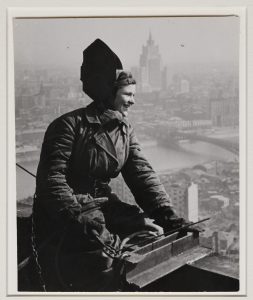

These aspects of the Soviet Union are relatively well-known by now; what is more intriguing to me is Baltermants himself and what we learn about him through his photographs. Truthfully, I’m not sure I really know anything with much certainty about him. There is perhaps more written about him or maybe by him in Russia, but I have had a harder time finding very many quotes by him or much about him outside of the occasional art biography from places that have done exhibitions on him. And so, what we have are his photographs and the questions that arise from them. He staged many of his photos to achieve the Socialist Realist ideal of the time, so even they are half-truths or hide a part of Baltermants as much as they reveal something about him. I get a sense of burden when I read his quotes. This one, for example, “In my time I was the leader of staged photography. I made some truly grandiose stagings.” There are some that could read that with pride behind it, but to me, using the term “grandiose” suggests overdoing or a kind of absurdity. Did he want to do his propaganda photos or was it just the way he made his living because he was rather good at it?
Below is one of his most famous photographs entitled “Grief”. To Baltermants, “War is, above all, grief. War is not for photography. If, however, heaven forbid, I had to photograph war again, I would do it quite differently. I agonize now at the thought of all the things that I did not photograph.” This quote is heartbreaking. It is interesting to hear of so much regret from someone that had a rather successful career. But when you see the photo, which is actually a series of photographs, you can understand the pain he feels. The intensity of the photo was enhanced by Baltermants; he altered the negatives to put in the dark, ominous clouds in the background. I wonder, what were “all the things” he did not photograph that he wished he would have? I am left with many questions about Baltermants; however, perhaps it is okay that they remain unanswered.