




by Mikaela Malsy, Collections Intern Summer 2024
This summer I had the incredible opportunity to work as an intern in the Collections department at the Wende Museum. This post was inspired by the Wende Museum’s open storage exhibition on the threat of nuclear warfare during the Cold War and its influence on American and Soviet culture as well as the recent release of the TV series Fallout. While the show portrays a strictly fictional set of characters set in a post-nuclear warfare America, it touches on many of the anxieties that were felt by real people throughout the duration of the Cold War. More importantly, the show made me curious as to how American and Soviet government agencies sought to temper those fears while simultaneously preparing their people for the possibility of their lives in a post-nuclear fallout society. For this reason, I wanted to use the Wende Museum’s collection of atomic age objects to examine the similarities and differences in how American and Soviet authorities aimed to inform people’s expectations of living in a post-fallout society.
While American and Soviet leaders and politicians postured for political power and leveraged their nuclear arsenals to gain the upper hand, neither government was entirely ignorant to the reality of what a nuclear fallout would entail for its people. Tension between the United States and the USSR rose to a fever pitch during the early 1960s with the construction of the Berlin Wall, the Bay of Pigs invasion in 1961, and the Cuban Missile Crisis in 1962. It was clear to government officials and most civilians that blast shelters-structures designed to withstand a direct attack from a nuclear warhead-would not be able to help anyone caught in the blast zone.(1) However, USSR and U.S. officials hypothesized that people who were located further away from ground zero might have a chance at surviving nuclear fallout if they had adequate preparation. Government officials began to publish and distribute posters, pamphlets, and booklets that directed civilians on every possible facet of how to survive in a post-nuclear fallout society. On the surface, advice distributed by the U.S. and the USSR officials appears to be almost identical, but the aesthetics and tone of each sides’ respective educational materials reveal a difference in how the U.S. and USSR conceived of their societies’ future in the wake of nuclear warfare.
Fallout in American Suburbia
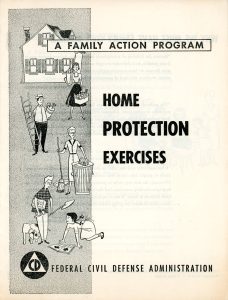
On July 25, 1961, President John F. Kennedy addressed the nation about the threat of imminent nuclear warfare, promising to increase the military budget and urging millions of Americans to build fallout shelters in their backyards and stock them with basic necessities they would require for survival.(2) In short order, the Federal Civil Defense Administration(FCDA) and its affiliated local agencies began to distribute pamphlets teaching families to construct their shelters in their own backyard. In this sense, fallout preparation took on a middle-class suburban quality as the majority of educational materials were addressed to families that could afford to own a home and possessed the land to build their shelter. Moreover, many pamphlets reiterated that civilians could build shelters out of materials that could be procured from a local hardware store for $150 or less-a cost that many lower-income and nonwhite families could not afford. Commonly recommended materials included plywood, sandbags, and concrete blocks.(3)
Guides also included details about how to ensure proper ventilation and water sanitation in shelters and how to provide basic first aid and treat the symptoms of radiation sickness.
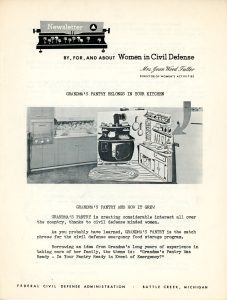
In an effort to mobilize women in the preparation effort-and perhaps enforce the perception of women being domestic caretakers of the home-the Federal Civil Defense Administration(FCDA) distributed newsletters that encouraged women to stock shelters with two weeks of food and water for their families. The administration referred to this program by the catchphrase of Grandma’s Pantry. Brands like Kelloggs, Campbells, and Spam leaned into this campaign by emphasizing the self-stable nature of their products as many materials urged consumers to stock up on canned or boxed foods and drinks.
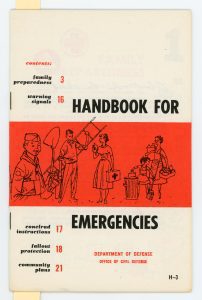
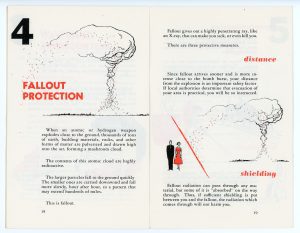
The last aspect and perhaps most point that informational materials touched upon was how to begin community recovery efforts. Detailed guides provided advice on how to decontaminate things ranging from home rooftops to farmland. Many booklets emphasized the importance of neighborhood-led efforts in the absence of government oversight. In this respect, American educational materials primarily focused on preparing people living in suburban and rural regions to adapt to post-nuclear warfare life rather than people who live in cities. This appeal to suburban and rural citizens could be interpreted in a couple of ways. On one hand, it would be reasonable to assume that large urban cities would be likely targets for bombings. However, it should be noted that the publication of these materials coincided with the migration of white, middle class families from cities to the suburbs and the use of redlining to keep non-white and lower-income families out of growing suburban developments. In this aspect, the FCDA’s focus on preparing their suburban and rural communities rather than their urban populations is indicative of how American government agencies were complicit in upholding existing racial and class hierarchies even under the threat of nuclear fallout.(4)
Fallout in Soviet Russia
In comparison to the abundance of media that drew upon the threat of nuclear warfare for inspiration and informational materials that American agencies distributed to its citizens, the Soviet government was more conservative with the amount of information it distributed to its citizens. The Soviet Atomic Project commenced in 1943 shortly after the Soviet government learned that the U.S. and Germany had begun to explore the possibilities of using nuclear fission to create a weapon. This project was highly confidential and relied upon information Soviet spies gleaned from the Manhattan Project and expertise from captured German scientists after the end of World War II. Consequently, the Soviets secretly conducted their first successful weapons test in August 1949 at the Semipalatinsk Test Site in Kazakhstan.(5) From that point forward, the Soviet Union conducted hundreds of tests, including over 200 atmospheric tests, exposing over one million people to radiation particles until the program’s termination in 1989. Consequently, a sizable portion of the USSR’s population was already living through the effects of nuclear fallout, albeit a fallout that did not radically alter the social and political structure of the USSR. The United States had similarly conducted over a thousand nuclear tests in Nevada and the various test sites throughout the Marshall Islands.(6)
With this in mind, it is not terribly surprising that educational materials distributed by the U.S. and the USSR provide almost identical information on how to give medical aid to those who have suffered radiation exposure and how to treat the materials exposed to radioactive particles. 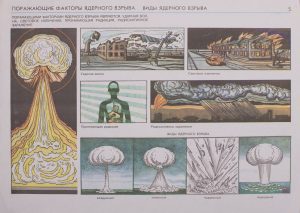
Notably, Soviet posters issue similar advice on how to construct fallout shelters. 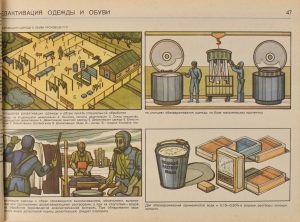
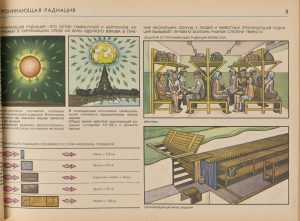
Essentially, the major points of departure between information given by Soviet and American government agencies pertained to the role that the agencies would play in the immediate aftermath of nuclear fallout and in the audiences that the governments aimed to reach. Whereas American materials seem to address a primarily suburban audience, the Soviet materials don’t seem to address any particular civilian population. For example, a Soviet poster prescribes how to create a community shelter and store food, but doesn’t go into any depth on the logistics of material costs, perhaps indicating that shelters would be collectively paid for and constructed by community members.
Moreover, soldiers are prominently displayed throughout many informational fallout materials, indicating the Soviet Union’s assumption that their military will retain its structure even after the beginning of nuclear warfare. In contrast, American civil defense pamphlets and posters rarely portrayed soldiers or state officials of any kind coordinating relief efforts and largely focused on mobilizing suburban populations.
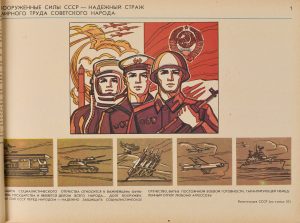
This difference was particularly interesting to me because it signals how the two states and their agencies conceived of the individual and family unit’s role in carrying out recovery efforts following nuclear warfare. For Soviet communities, relief efforts would be carried out as a collective unit in coordination with the central government. There seems to be no doubt that the state apparatus would not only survive the beginning of nuclear warfare but also be able to coordinate their resources. In contrast, Americans would have to rely on their immediate communities and local agencies to survive with seemingly no guarantee of aid coming from the federal government. American communities would have to rely on their own preparation, the good will of their neighbors, and good luck to survive whatever nuclear fallout entailed. Nonetheless, American and Soviet visions of their societies’ futures share one key feature: the belief that their people and their fundamental values would find a way to survive in a future defined by nuclear fallout.
References
(1) “The Price of Life” Time no. 23, December 2, 1957. https://time.com/vault/issue/1957-12-02/page/17/.
(2) Television Network Columbia Broadcasting System Collection. Report to the Nation – Berlin Crisis, 25 July 1961, https://www.jfklibrary.org/asset-viewer/archives/tnc-258.
(3) Fallout Protection : What to Know and Do About Nuclear Attack. Department of Defense, Office of Civil Defense, 1961. https://www.dahp.wa.gov/sites/default/files/Fallout%20Protection%20What%20to%20Know%20and%20Do.pdf.
(4) For further reading on how fallout shelters represented a turning point in American cultural attitudes toward the Cold War and the threat of atomic warfare, see Kenneth D. Rose. One Nation Underground: The Fallout Shelter in American Culture. New York: New York University Press, 2004.
(5) “Soviet Atomic Program – 1946.” Nuclear Museum, June 5, 2014. https://ahf.nuclearmuseum.org/ahf/history/soviet-atomic-program-1946/.
(6)“End Nuclear Tests Day – History.” United Nations. Accessed October 16, 2024. https://www.un.org/en/observances/end-nuclear-tests-day/history#:~:text=Underground%20testing%20means%20that%20nuclear,conducted%20by%20the%20Soviet%20Union.