
by Sara Abrahamsson, Collections Intern Summer 2024
I had the opportunity to handle and research a wide variety of objects while working as Collections Intern at the Wende—ranging from a collection of identification documents from the Czechoslovak Socialist Republic, to Hungarian uniform armbands, and several Soviet demobilization albums (assembled by soldiers at the end of their mandatory military service terms). However, in my final weeks at the Wende, I turned my attention towards the collection’s revolutionary Cuban posters and began working to further develop our database’s records, in preparation for the addition of a section on Cuban posters to the Wende’s recently relaunched online collections. This work built on the knowledge and skills I developed while writing my senior thesis at UCLA, titled “Picturing Nixon: OSPAAAL’s Visual Languages of Anti-Imperialism.”
My Cuban poster work at the Wende, namely in the context of a museum collection focused on the Cold War era, allowed me to reshape my approach—merging my existing art-historical understanding of revolutionary Cuban posters (referring to those produced after the Cuban Revolution in 1959), with a greater attention to collection concerns relating specifically to political posters, as well as the manner in which each poster’s condition evidences the shifting nature of such works between their designations as art objects, collection objects, and everyday objects.
Revolutionary Cuban posters were published by an array of entities, with two being most pertinent in the Wende’s collection: the Organization of Solidarity with the Peoples of Africa, 
Of the three posters in the Wende collection published by EP, all feature the unmistakable likeness of leader of the Cuban Revolution, Fidel Castro, in the context of calls for national pride and defense. This is somewhat unusual in the overall body of revolutionary Cuban posters, which are rarely known to feature Castro’s likeness.[2] In this way, the Wende’s collection of Cuban posters is best situated within the institution’s historical niche and collection goals, as these objects cannot serve to represent a sample of Cuban posters (or even the output of Editoria Política specifically), but perhaps more so an opportunity to relate and compare to its other non-Cuban Cold War materials. In this case, representations of Castro could be studied and exhibited side-by-side with those of Vladimir Lenin, for example, from the Soviet Union.
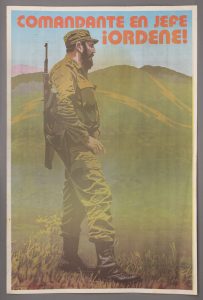
Comandante en Jefe !Ordene! (1961), published by the Department of Revolutionary Orientation (Departamento De Orientación Revolucionaria), later known as Editoria Política. 2021.013.002
OSPAAAL, on the other hand, was founded in 1966 as an international organization, though its headquarters remained in Havana, Cuba throughout its lifetime, and the majority of its posters were designed by Cuban artists. Though funded primarily by the Cuban state, it was not an official government entity. OSPAAAL’s posters were distributed internationally via Tricontinental, the organization’s bimonthly magazine. In each issue, an artwork was folded up, inserted into the magazine’s pages, and mailed to subscribers—-a far more nonchalant approach than costly traditional methods of shipping works on paper that involve extensive packaging. With such an efficient system, posters were mailed to as many as eighty-seven countries, with the magazine’s distribution reaching a high of 30,000 copies in 1989. After reaching their destinations, these posters could be found on display in anti-imperialist community centers within nations as politically distant as the United States, shared between comrades of Tricontinental subscribers, and tacked up on the walls in a recipient’s own community.
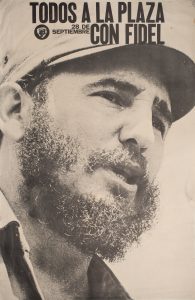
Details of Todos a la plaza 28 de Spetiembre Con Fidel (1960) published by the Committees for the Defense of the Revolution (Comités de Defensa de la Revolución, CDR). 2021.013.004
Given the more casual attitude towards handling, distribution, display, and storage taken by publishers and viewers of Cuban posters, none of the Wende’s Cuban posters that I surveyed in my project are in pristine condition, and very few revolutionary Cuban posters are. Each is characteristically complete with its own unique thumbprint of wear; with evidence of its life thus far—pinholes from being displayed on murals, large bulletin boards adorned with posters, photographs and clippings, stationed at the entry to the headquarters for a neighborhood’s Committees for the Defense of the Revolution (CDR) found on every city block;[3] rips and tears from being gracefully retired from its mural to be replaced with a more pertinent artwork or piece of ephemera; fold marks from being mailed within the pages of an issue of Tricontinental, and wear along the edges and corners from being folded and unfolded repeatedly, such as in the case in Folding Nixon.
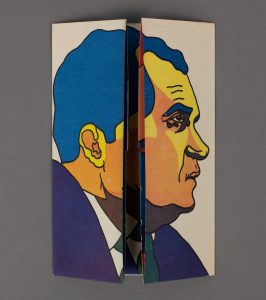
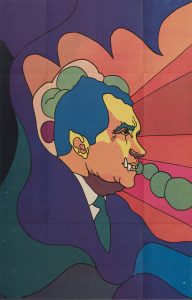
Folding Nixon (1972) by Alfredo Rostgaard, in its folded and fully unfolded state. 2017.048.005
As museum professionals, we commit our careers to preserving objects and art so that we may appreciate and learn from them for generations to come. This mission is complicated by artworks that function as living material culture, such as Cuban posters—which meaningfully brought art into the public sphere and private lives of many, especially those who never had the means to own art otherwise.[4] For this reason and others, political posters are not always well described by the institutional classification of “art object,” as they were not produced or originally enjoyed with this purpose in mind. Understanding these intentions, alongside the important role many of these posters played in movements both domestically and internationally, it is almost sad to imagine such powerful objects being laid to rest in a flat file.
Even with their significant damage aside, limitations are imposed when displaying and handling Cuban posters, given the inherent fragility of paper works. A perfect solution to this contradiction feels distant, though digitization initiatives such as that of the Wende can offer increased world-wide access to such collection objects, all while allowing the integrity of posters in well-loved condition to be protected. Digitization should be undertaken with urgency, given the inevitable degradation of the paper and inks (often of low quality due to material shortages in Cuba) used to produce revolutionary Cuban posters.[5] Another implication that faces researchers and collection managers working with Cuban posters is a general lack of information on Cuban poster production and the organizations that facilitated it. For example, OSPAAAL ceased its operations in 2019, and according to an account of its closure, the organization “donated a good part of the graphic archives to several embassies of allied governments, especially of countries that were part of the solidarity cause at some point,” though it is unclear which specific institutions received its archives and materials. Similarly, surely due to diplomatic tensions, any Cuban archives of Editoria Política’s materials remain relatively inaccessible to American scholars. Given this disconnect and its resulting limitation on Cuban poster scholarship, most texts on revolutionary Cuban posters present general facts and analysis on their existence as a body of work, and less so as individual posters. As such, my ability to uniquely contextualize each poster in the Wende’s collection was limited.
Revolutionary Cuban posters, much like the rest of the Wende’s collection, evidence ongoing human experiences and political struggles, and should be researched and presented as such despite the aforementioned challenges we face in this task. Cuba’s posters become especially relevant for museum audiences today, given its ongoing national struggle, and the United States’ continually imposed blockade against it, despite longstanding movements to end such sanctions. As an example of this link between past and present found within the collection, Rafael Enriquez’s World Solidarity with Cuba poster, refers glaringly to the blockade as a lethal weapon—not unreasonably so, given that the United States’ policies have caused Cuba to lose trillions of dollars over the past six decades by severely limiting its access to international trade.[6]
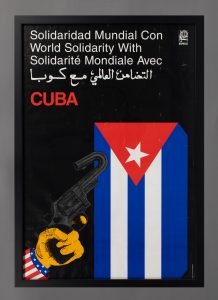
World Solidarity with Cuba by Rafael Enriquez, published by OSPAAAL. 2017.048.006
Continuing opportunities for work on this Cuban poster project at the Wende could include the production of higher quality photographs of each poster, and the inclusion of the newly developed poster records to Bloomberg Connects for increased public access. I look forward to seeing how visitors and supporters of the Wende Museum will engage with a heightened level of accessibility to these iconic artworks.
[1] Lincoln Cushing, Revolución!: Cuban Poster Art (San Francisco: Chronicle Books, 2003), 10.
[2] Cushing, Revolución!, 16.
[3] David Kunzle, “Public Graphics in Cuba: A Very Cuban Form of Internationalist Art,” Latin American Perspectives 2, no. 4 (1975): 102, http://www.jstor.org/stable/2633221.
[4] “The Art of the Revolution Will Be Internationalist,” Tricontinental: Institute for Social Research, no. Dossier no. 15 (April 9, 2019): 15.
[5] Susan Tschabrun, “Off the Wall and into a Drawer: Managing a Research Collection of Political Posters,” The American Archivist 66, no. 2 (2003): 318-320.
[6] “Economic, Commercial Embargo Imposed by United States Against Cuba Harmful, Violates UN Charter, Speakers Underline in General Assembly,” United Nations, November 1, 2023, https://press.un.org/en/2023/ga12552.doc.htm.