

by Alicia Mara, Collections Intern Winter 2025
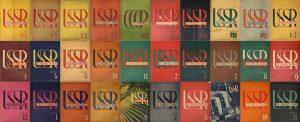
USSR in Construction isn’t your typical magazine. Nearly 18 inches long, visually striking and carefully designed, the magazine was designed to make an impression. Each issue functioned as both a work of graphic design and a vehicle for Soviet state propaganda. Published from 1930 to 1941 (and briefly again in 1949), the magazine was produced in multiple languages and created to showcase the Soviet Union to international audiences as modern, unified, and endlessly progressing. The Wende Museum holds nearly 90 issues of this publication, and I had the opportunity to help make this collection digitally accessible.
As a Collections Intern, I led the digitization of the USSR in Construction collection while working closely with the Collections Managers, Christine Rank and Kathryn Ung. Drawing from my background in marketing photography, I helped set up a professional overhead digitization station, created documentation for photography workflows, photographed, and edited each page to transform the issues into high-quality, digitally navigable magazines.
Each issue combines photography, photomontage, and experimental layouts to craft a curated vision of Soviet life. Founded by Maxim Gorky and featuring work by some of the Soviet Union’s leading photographers, artists, and designers, the magazine was as much a cultural project as a political one. What makes these magazines especially notable is their bold use of color printing, special fold outs, and dramatic compositions.
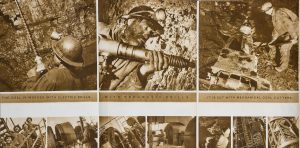
An interesting foldout design in USSR in Construction No. 2, 1935, focused on coal mining in Kuzbass
The content spans an astonishing range of subjects, from collective farms, steel mills, and aviation to Arctic expeditions, transportation infrastructure, childcare programs, women’s education initiatives, and public housing projects. They also highlight locations across the entire Soviet Union, not just within the borders of present-day Russia. The magazines weren’t simply documenting industry; they were presenting a curated vision of an entirely new society. A new unified, modern Soviet identity.
USSR in Construction No. 9, 1933
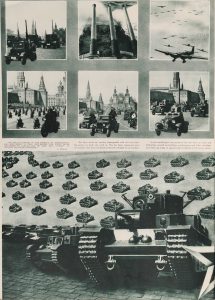
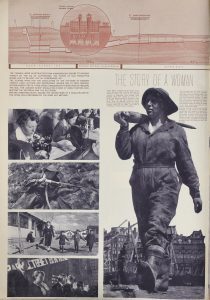
Left: USSR in Construction No. 7, 1939
Right: USSR in Construction No. 8, 1935
One of the most visually exciting issues is a 1933 magazine focused on Soviet agricultural exhibitions and scientific expeditions. It makes bold use of color, such as bright orange overlays against grayscale photographs. Through interesting and vivid design choices, the issue positions the USSR as both a scientific leader and an agricultural innovator, using visual storytelling to transform crops and research projects into symbols of national progress. Another issue centered on public health takes a similar approach, presenting hospitals, mother and child care, and free universal medical services as evidence of a compassionate and well-organized society.
USSR in Construction No. 7, 1949
But perhaps one of the most politically revealing issues is the 1949 issue commemorating Joseph Stalin’s 70th birthday. Across dozens of pages, it mythologizes Stalin’s life, from his revolutionary beginnings to his military triumphs, reinforcing his image as both architect and savior of the Soviet Union. A decade earlier, a 1939 double issue dedicated to the Central Lenin Museum similarly presents Lenin’s life through a structured visual narrative of photographs, documents, and illustrated spreads. As I worked with these materials, I found myself thinking less about what the magazines were showing, and more about how they were showing it. What values were embedded in the images? What narratives were being constructed through layout and design?
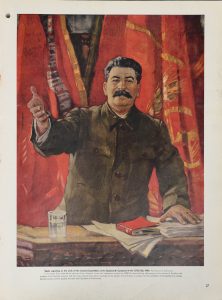

Left: USSR in Construction No. 12, 1949
Right: USSR in Construction No. 4-5, 1939
Working so closely with the collection also inspired my UCLA Digital Humanities capstone project that expanded on this digitization work. Using the newly accessible magazines, I developed an interactive network visualization (below) that maps connections between themes, geographic locations, and cultural figures across the publication’s early years. “USSR in Construction: An Exploration of Soviet Networks, Themes, and Ideology (1930–1935)” explores how narratives of industrialization, modernization, and Soviet identity were constructed across issues and time.
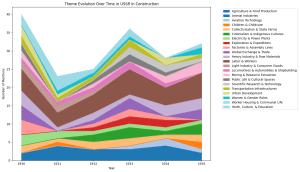
Getting to work with such a unique, special collection was such a meaningful experience. This project deepened my understanding of how design and ideology intersect, how visual storytelling shapes historical narratives, and how digital tools can create new ways of exploring archival materials. It also reinforced the importance of digital access in connecting researchers and the public with collections that may otherwise be difficult to discover and use.
Interested in exploring the collection yourself? Browse the nearly 90 digitized issues in full through the Wende Digital Collections Portal. Whether viewed as works of graphic design, historical documents, or artifacts of political communication, these magazines offer a window into how the Soviet Union aimed to represent itself to the world.
About the Author: Alicia Mara is a data professional working at the intersection of collections, technology, and access. As a digital collections specialist, archivist, and educator, she works to expand access to archival and cultural heritage materials through digital collection management, metadata, and digitization. She holds an MLIS from UCLA with a specialization in Archival Studies and a certificate in Digital Humanities and serves as a Lecturer in the UCLA Department of Information Studies.