
by José Rodriguez Cortez, Collections Intern Summer 2025
Sport is power. It can be wielded as a political tool, used to influence national and personal identities, serve as a platform for activism, shift culture, and even throw entire economies into disarray. It is intricately entangled in all aspects of society. It is no surprise then that to this day, governments tout sporting achievements as evidence of their ideological dominance.
Sport is also community. It, perhaps more than any other cause, galvanizes us to come together to dream, smile, and celebrate regularly. It is an ever timely reminder of what we can achieve in the face of adversity when we unite against a familiar cause. As the biggest sport in the world, football, also known as soccer, embodies these two opposing ideas.
Football has existed in some shape and form for the last 2,000 years, but modern rules were only standardized in 19th-century England. According to some accounts, the first official team established outside of Britain was the Dresden English Football Club in 1874. The German Football Association was formed shortly after on January 28, 1900, in Leipzig. Football in Germany was born in the East.
However, as of the 2025-26 Bundesliga season, there are only two teams from East Germany playing in the top-flight: 1. FC Union Berlin and RB Leipzig. The latter was only founded in 2009, making Union the only historic East German side in the Bundesliga. As a life-long football fan interested in the intersection of sport and politics, I decided to catalog a handful of Cold War-era East German football items for my final project as a Collections Intern in hopes of better understanding how this came to be.
After WWII, football in East Germany underwent several notable changes. The first of these came in 1949, when football, as well as other sports, were allowed to restart after being banned under Soviet occupation immediately after the war. This year also marked the creation of the DDR-Oberliga, East Germany’s top football league. After a few rocky years, East Germany’s Football Association (DFV) attempted to improve the competitiveness of the league in 1954 by forcibly merging, relocating, and restructuring several teams. State-owned company teams (BSG) were replaced with sports clubs (SC) that were more football-focused (e.g., BSG Chemie Leipzig became SC Lokomotive Leipzig). This action angered fans who saw this as catering to the political and commercial interests of a select few.
One of the items I was able to catalog and digitize during my internship was a 1954-55 VEB Sport Toto commemorative photo album. It was created as a way for collectors to showcase their collectible photographs from that season of sports. Half of the album is dedicated to football. It contains a full record of that year’s newly formed teams with complete lineups and a team photo for each club that competed in the Oberliga. The eventual winner for the year, SC Turbine Erfurt, features prominently. This album also features photographs from the 1954 World Cup won by West Germany. This momentous West German win was one of the catalysts for the reorganization of the East German teams by the DFV, who wanted to prove that they, too, could field great players and teams capable of competing with the rest of the world.
One of the teams hardest hit by this reorganization was Dynamo Dresden. Leading up to the 1954 league shake-up, Dynamo Dresden proved to be a capable club after winning the 1952-53 Oberliga. This caught the attention of Erich Mielke, Head of the Stasi, who oversaw SV Dynamo, the larger sports group under which Dynamo Dresden fell. As part of the larger restructuring of 1954, Mielke decided to strip Dynamo Dresden of their place in the Oberliga, move most of the squad to Berlin, and rename them SC Dynamo Berlin (later BFC Dynamo). The few players who opposed this decision were allowed to continue competing as Dynamo Dresden but were relegated to the second division of East German football. The team struggled to achieve any level of success for the next 10 years. Things began to improve for Dynamo Dresden after a second league restructuring in 1965.
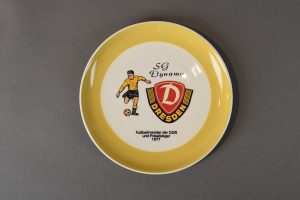
With little international success to point to by 1965, the DFV decided to separate some football clubs (FCs) from their larger sports clubs in an effort to improve the level of the league as well as the recently established East German national team. The benefits that came with this special designation proved to be the missing puzzle piece for Dynamo Dresden. The football club would go on to win 5 league titles during the 1970s, winning the domestic double (league and cup) two times during this spell in 1971 and 1977. This plate, another item from the Wende’s collection I worked on, commemorates the club’s 1977 double-winning season and features the DFV’s logo on the back.
The 1980s saw BFC Dynamo, fueled by Mielke’s influence and power, become the dominant club in East Germany with 10 consecutive Oberliga wins. SG Dynamo Dresden regained the title in 1989 and achieved its third domestic double in 1990.
Though the 1965 formation of dedicated football clubs most noticeably benefitted Dynamo teams, it also resulted in greater international success for East Germany. The 1970s saw East Germany beat West Germany at the 1974 FIFA World Cup, 1. FC Magdeburg win the 1974 European Cup Winners’ Cup, and East Germany win the gold medal in football at the 1976 Olympics. State-controlled football clubs seemed to be paying dividends at last; however, this would also prove to be East German football’s downfall.
With the fall of the Berlin Wall in late 1989, the end of the Oberliga felt inevitable. Before the start of the 1990-91 season, it was announced that the top two teams would qualify for the new, unified Bundesliga; Hansa Rostock and Dynamo Dresden would go on to finish 1st and 2nd. The rest of East Germany’s teams were relegated to lower divisions based on their table placement. Regardless of where they ended up, East German teams struggled to succeed.
The region’s best players were poached by wealthier, more successful West German teams almost immediately after the fall of the Berlin Wall. Moreover, East German clubs struggled to remain solvent after unification because so many had been state-run and funded for decades. Without proper protection and support from the German Football Association (DFB), which treated the integrated teams more like East Germans than Germans, few successfully adapted to their new circumstances. Even Dynamo Dresden, which can trace its origins back to the Dresden English Football Club, became a mainstay of Germany’s lower football divisions.
With the recent promotion of Union Berlin to the Bundesliga, there is renewed interest in the history and legacy of East German football. The Wende’s East German football collection paints a rich picture of the highs and lows of the sport during a period of transformation, and I am grateful to have contributed to it during my internship. I now have a deeper understanding and appreciation of what makes German football so unique. If you want to learn more about this era of German football, the Wende’s Online Collection is a great place to start.