

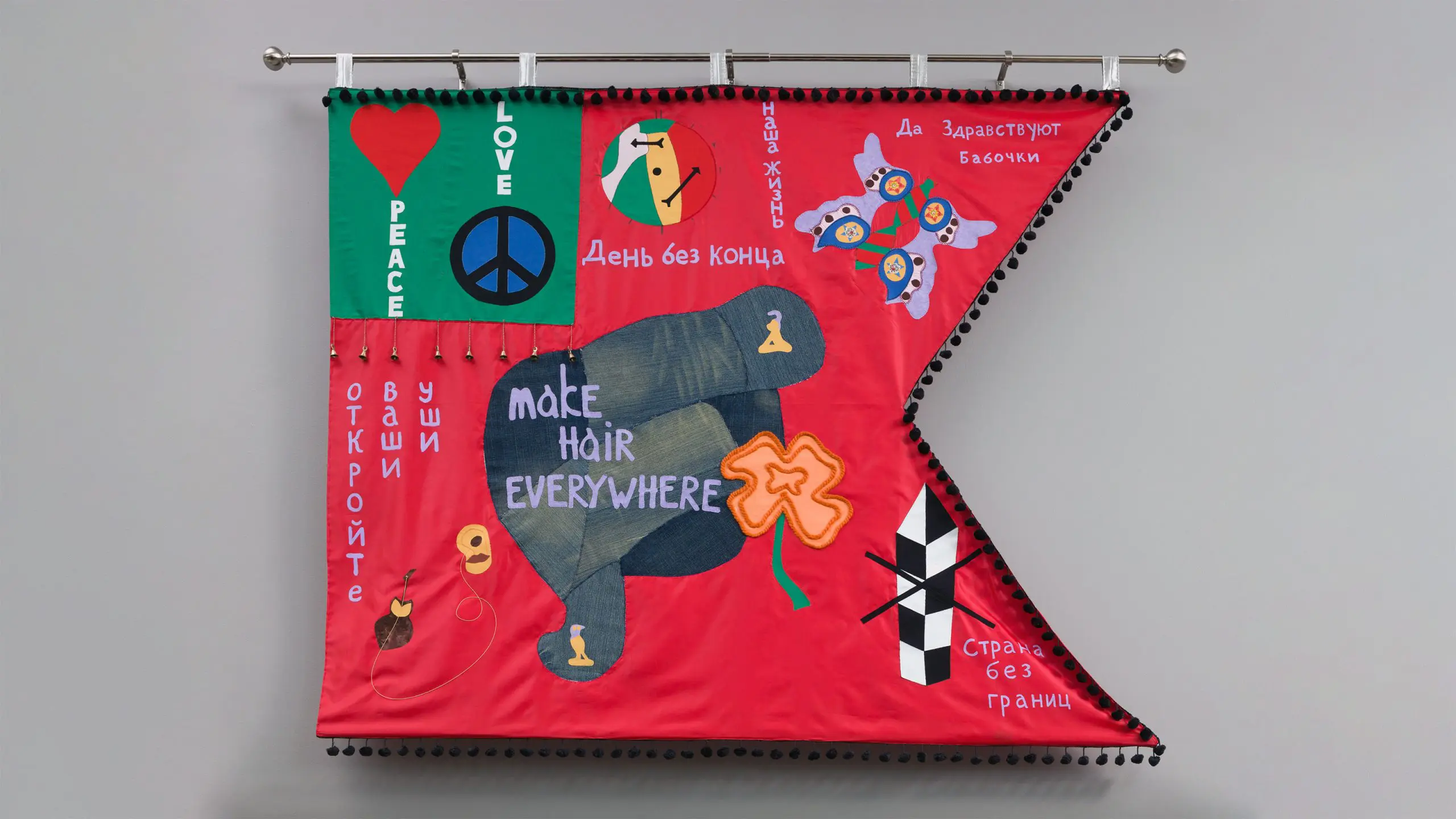
Join us for Samizdat Sundays—hands‑on textile workshops inspired by the spirit of creative resistance and DIY culture found in samizdat traditions. Each week offers a different project, connecting archival stories of subversion with contemporary making.
We encourage participants to bring an item each week—a T‑shirt, a pair of jeans, or any textile you’re ready to transform, repair, or experiment with.
Each session is free, open to all skill levels, and guided by artists who delight in subversion and play. Come for one or come for all—together we’ll stitch, alter, repair, and imagine new forms of expression.
Join us for Samizdat Sundays—hands‑on textile workshops inspired by the spirit of creative resistance and DIY culture found in samizdat traditions. Each week offers a different project, connecting archival stories of subversion with contemporary making.
August 2: I am HERE. Today, we will make a piece that declares we are here, in this time and space. We will look at the work of On Kawara, Tehching Hsieh, Sho Shibuya and JB Daniel, artists who have made a practice of documenting their days as they lived them. Sometimes these works are incredibly simple, like the date/time works of On Kawara or the daily sky photos of JB Daniel; sometimes they are more complicated, like the beautiful paintings Sho Shibuya has made on the front cover of the daily New York Times since the Covid lockdown. What will you make to declare “I am here,” to document your experience today? Will you begin with our latitude/longitude? The time on your smartphone? Or will you begin with a memory or a feeling or a color? Your work can be a collage or a drawing or a textile, or perhaps a combination of all three.
August 9: Time Capsule. There are time capsules being prepared across the country in celebration of the 250th anniversary of the signing of the Declaration of Independence (you can read about the 50-state one here: https://america250.org/time-capsule/contents/). These capsules will be buried, sent into outer space, opened early and perhaps lost for good. Many time capsules are PR stunts, but as my friend archaeologist Shannon Dawdy proposed in her Chronoscope Substack newsletter recently (https://shannonleedawdy.substack.com/p/so-whats-in-your-time-capsule), “we use time capsules to try to understand — or to assert — what this present moment is all about and to project ourselves into the future.” Today we will make an object for a theoretical time capsule. Perhaps you really will send yours into the future by burying your object or adding it to a local time capsule, or perhaps your time capsule is conceptual rather than physical. What object would you like to make for the future?
August 16: The Time-Keeper Appliqué/Embellishment. Have you met someone who has tattoos that mark a period in their life (or do you yourself have such a tattoo)? Throughout human history, people have embellished their bodies and their clothing to reflect their lives as they lived them. Soldiers wear medals and patches that declare aspects of their service and training; tattoos and scarring may document rites of passage and other transitions; backpacks and jean jackets may be decorated with patches and pins from festivals, camps, schools, travels, etc. In today’s workshop, we will add an applique or embellishment to a favorite piece of clothing, bag, or other object, as a reminder of this time of our lives. Perhaps you will begin by making a decorated patch; perhaps you will move straight into embroidering your object directly; or perhaps your embellishment will be hidden from view, only known to you. Bring a textile (or two) to play with — a canvas bag, a shirt, a pair of pants, a bandana — whatever you would like to transform into a time keeper.
August 23: Hidden Pocket. Today we will reprise a popular workshop from last summer: the hidden pocket. Hidden pockets have been used for millennia to hide, conceal, and keep safe objects that the wearer does not want others to see (at least not when they’re walking around town). During the Soviet Era, hidden pockets in large overcoats were used to transport handwritten Samizdat. In the Iron Age, a woman who lived in modern day Denmark wore a cloak with a secret pocket sewn closed (she is known as the “Huldremose Woman.”) that contained small objects that have been described by archaeologists as talismans and charms. Today we will sew a hidden pocket into a piece of clothing (and perhaps make an object or two to keep in the pocket as well), or make a small pouch that can be worn around our necks and hidden in our shirts, or around our waists and hidden in our pants. Perhaps your hidden pocket is visible from the outside, even if it’s contents are not, or perhaps your hidden pocket is truly hidden from everyone but you. What will you keep in your pocket?
August 30: Finish It Clinic. Today, we will finish up projects. If you don’t have anything to finish, don’t despair! Come and I will give you a project from a past workshop to do during our time together.
About the teaching artist
Kate Ingold is an LA-based artist and poet working with the discarded, the damaged, and the worn out. Materials and methods include textiles, collage, photography, video, ceramics, and performative installation. She works in series driven by conceptual concerns and is currently making work in two interwoven projects: Relics for Future Rituals and Damaged Goods/Small Repairs.
RSVPs for this free program do not guarantee admission. Limited seating is available on a first come, first served basis.
An ADA-accessible entrance to the Wende Museum Community Center is available through the garden gate from the parking lot. This gate will be opened approximately 15 minutes prior to the program.