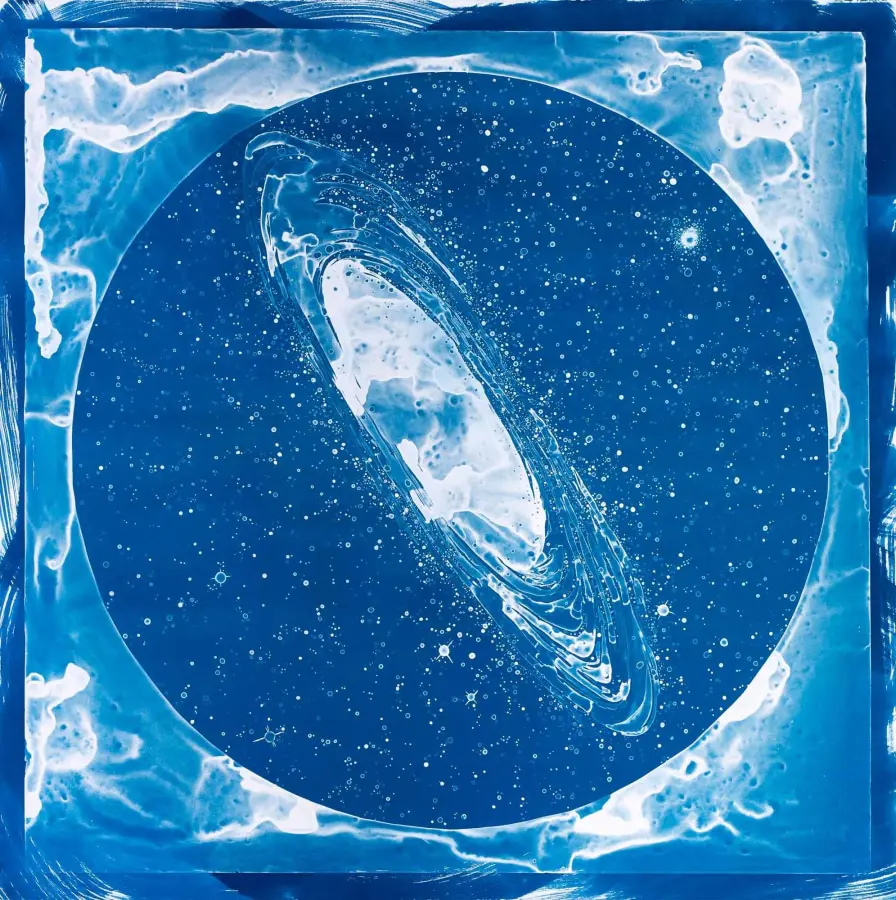
Lia Halloran, Andromeda, After Mollie O’Reilly, Your Body Is a Space that Sees, 2017. Courtesy of the artist and Luis De Jesus Los Angeles
Culver City, CA (August 27, 2026) — The Wende Museum presents Competing Cosmologies: Interpreting the Sky, an exhibition examining how artists around the world have been and continue to be inspired by outer space during and after the Cold War. Co-curated by the Wende Museum’s Chief Curator and Director of Programming Joes Segal, Associate Curator Emma Diffley, and NASA historian Lois Rosson, the exhibition brings together an international mix of more than 170 artworks, historical artifacts, films, and archival materials, examining how advances in astronomy and space exploration were interpreted through diverse cultural, political, and social perspectives.
Organized into four thematic sections—Astronomy, Space Race, Futurisms, and Aliens—the exhibition pairs historical artifacts with Cold War-era and contemporary art to explore the relationship between discovery and artistic imagination. Together, the works reveal how the cosmos has served as a site of scientific inquiry and as a source of creative expression, political symbolism, and speculative thought.
“We often look back at the Cold War—not just the Space Race—as an era defined by an unbridgeable geopolitical divide,” said Dr. Joes Segal, Chief Curator and Director of Programming at the Wende Museum. “Competing Cosmologies qualifies that narrative by showing how artists around the world connected through reflections on outer space. It shows how the cosmos became a shared space for imagination as well as exploration.”
Highlights of the exhibition include rare Soviet spacecraft models of Sputnik-1, Vostok, Luna 9, and Mars-3 from Jay Walker’s Library of Human Imagination, representing milestones including the first artificial satellite, first human spaceflight, first soft landing on the Moon, and first spacecraft to land on Mars, as well as Randii Wessen’s space collection, including pieces of the Moon, Mars, and a meteorite pre-dating our solar system. The exhibition also features Soviet archival materials from the Wende Museum’s collection—including original photographs of Yuri Gagarin, handmade albums, magazines, porcelain, and consumer objects—that document how the Space Race shaped everyday life and visual culture in the Soviet Union.
Other highlights include five paintings by pioneering space artist Chesley Bonestell on loan from Adler Planetarium; three monumental paintings by Lia Halloran, who worked closely with astrophysicist and Physics Nobel Prize winner Kip Thorne; Paul Laffoley’s cosmological paintings; Ionel Talpazan’s UFO diagrams; and the rarely exhibited works by experimental Ukrainian artist Fedir Tetianych, including artist-made space costumes and designs for his visionary Biotechnosphere projects, from the Tetianych family archive in Kyiv.
“For generations, the stars have served as both a destination and a mirror—inviting speculation about humanity’s future while reflecting the conditions of life on Earth,” said the Wende Museum’s Associate Curator Emma Diffley. “Artists like Laffoley, Talpazan, and Tetianych each turned to the cosmos as a way to explore questions of existence, technology, society, and survival, creating visionary works that transform space from a distant frontier into a place of possibility and profound wonder.”
The contemporary artists featured in the exhibition are Chelle Barbour, Pyotr Belenok, Nuotama Bodomo, Beatriz Cortez, Bettina Forget, Chitra Ganesh, Mark Steven Greenfield, Lia Halloran, Jitish Kallat, Li Tianbing, Aaron Samuel Mulenga, Leo Raudys, Trương Minh Quý, David Van Eyssen, and others, whose work considers astronomy, migration, identity, speculative futures, and humanity’s relationship to the cosmos.
“Space exploration was shaped, undeniably, by the geopolitical conflagration we know as the Cold War,” said exhibition co-curator and NASA historian Lois Rosson. “This is the subject of Competing Cosmologies, which offers both an art exhibition and a history lesson. On their own, the exhibition’s artworks represent profound aesthetic interventions, but taken together, they form a crucial new archive of outer space as seen at human scale. Rather than treating science and culture as distinct entities, Competing Cosmologies reminds us that science is culture.”
Competing Cosmologies opens amid renewed interest in space exploration with NASA’s Artemis missions, plans for human exploration of Mars, and advances in astrobiology fueling public fascination with humanity’s future beyond Earth. The exhibition looks at the cultural legacy of the Space Race and invites visitors to consider how different societies have interpreted the cosmos and what those visions reveal about life on Earth.
The exhibition will be accompanied by a catalog featuring essays by exhibition co-curators Joes Segal, Emma Diffley, and Lois Rosson, and exhibiting artist Lia Halloran. A series of public programs including lectures, artist talks, performances, film screenings, and panel discussions exploring the intersections of art, science, and space exploration will be presented in conjunction with the exhibition.
The Wende is a museum, archive, and cultural center where art, history, and community come together. Founded in 2002 and based in Culver City, California, the Wende is dedicated to rescuing, preserving, and activating at-risk historical collections, especially those connected to dissident movements, civil society, and human rights advocacy.
“Wende,” a German word meaning “turning point” or “transformation,” reflects the origins of the collection. It also points to the institution’s broader mission: to illuminate historical moments of change and bring them into contemporary conversation. Learn more at wendemuseum.org.
For media inquiries, images, or interview requests, please contact:
Jessica McCormack | jessica@seehearspeak.agency | 323-497-9308
Andrew Hartwell | communications@wendemuseum.org | 310-216-1600 x305